

Imagine a U.S.-based company with customers in Europe, suppliers in Asia, contractors in Latin America, and several operating subsidiaries.
A customer in Germany pays an invoice. The payment moves through the banking system before appearing in the company’s account. Finance records the receivable. Treasury eventually sees the cash. Some of that money may need to be transferred to another entity. A supplier in Singapore is waiting to be paid. Another system handles that transaction. Accounting will later reconcile the payment against the appropriate invoice.
None of this is particularly unusual. It is simply how businesses move money. And that is precisely why stablecoins may matter more than they initially appear to.
Most conversations about stablecoins focus on the moment money travels from one party to another. Faster payments. Lower-cost international transfers. Twenty-four-hour settlement.
Those are legitimate benefits.
But if stablecoins are evaluated only as another payment method, businesses may miss the larger opportunity. The more consequential change comes when the same digital form of money can be used across several parts of the company's financial workflow.
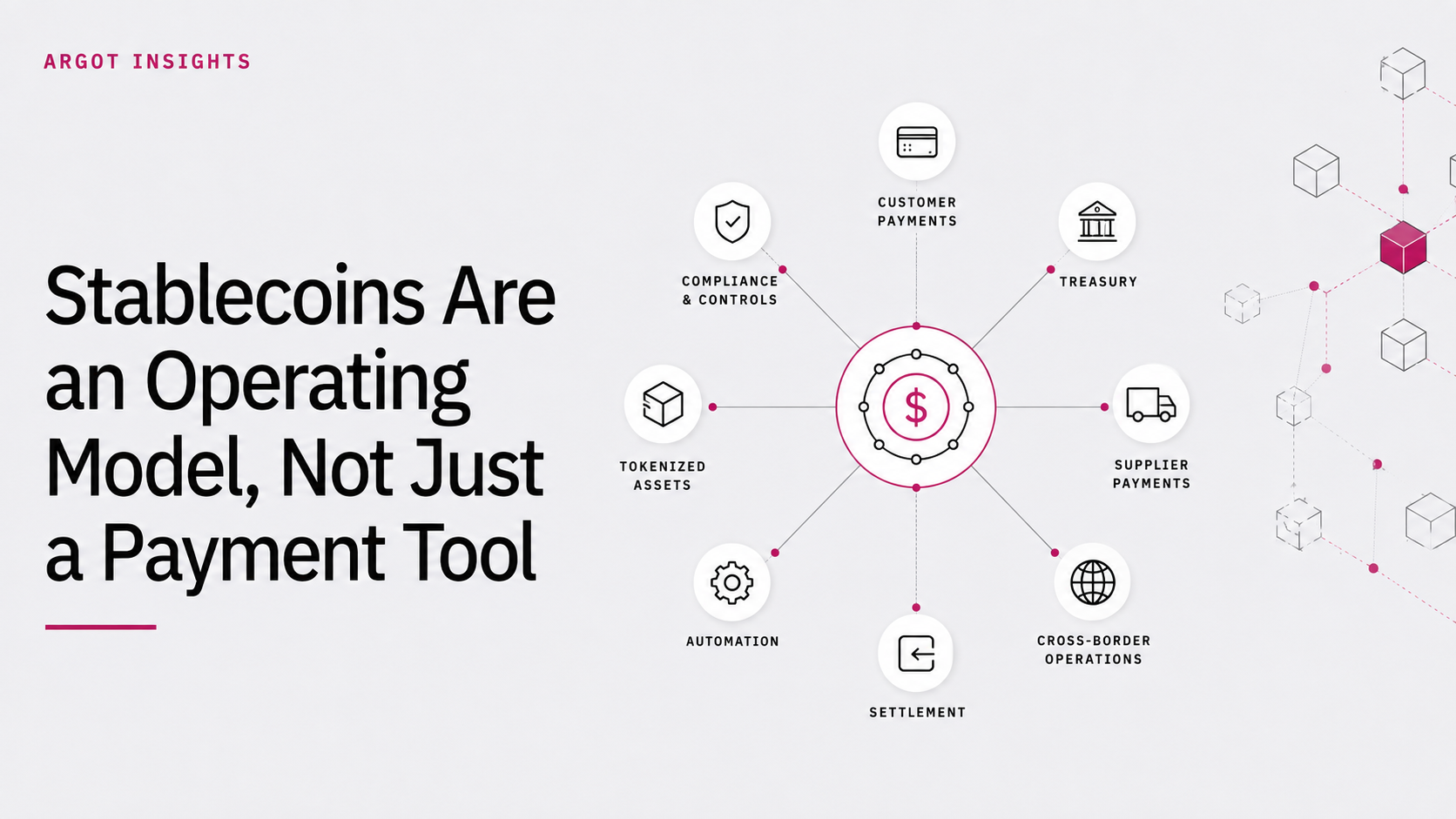
Instead of thinking about stablecoins as a payment product, it may be more useful to think of them as a potential operating layer for money.
Follow the Money Through the Business
Return to our hypothetical company.
Today, money and information about money often travel along separate paths.
- The customer transaction exists in one system.
- The payment moves through another.
- The bank maintains another record.
- The accounting platform records another.
- Treasury has its own view of available cash.
- The supplier sees only whether its invoice has been paid.
Eventually these systems have to agree. That creates a substantial amount of invisible work.
- Reconciliation.
- Payment instructions.
- Bank integrations.
- Settlement delays.
- Cash positioning.
- Foreign exchange.
- Liquidity transfers.
- Exception handling.
- Compliance checks.
The problem is not necessarily that any one part of the system works badly. The problem is that each part has been built around a different institution, ledger, operating window, or technical environment.
Stablecoins introduce another possibility because the money itself can exist as a digital asset on network infrastructure.
That means the same unit of value used to receive a payment might also be used to move liquidity, pay another counterparty, settle a digital asset transaction, or trigger an automated financial action.
The significance is not the stablecoin alone. It is what happens when several financial processes begin operating around the same digital cash layer.
A Payment Can Become Part of the Transaction
Suppose the company pays a supplier today.
The commercial agreement and the payment are related, but they are not the same event.
- The supplier delivers.
- An invoice is created.
- The invoice is approved.
- Someone or some system instructs a financial institution to make a payment.
- The banking infrastructure processes the transaction.
- The receiving institution credits the supplier.
- The two companies reconcile their records.
Software has already automated much of this process, so none of this should be confused with the idea that automation itself is new. What stablecoins potentially change is the relationship between the software and the money.
A blockchain-based dollar can exist inside a programmable environment. That creates the possibility for payment to become more tightly connected to the commercial action that produced it.
Delivery could trigger release of funds.
Completion of a project milestone could release a predetermined payment.
Marketplace revenue could be divided automatically among several parties.
A transaction could proceed only when defined compliance requirements have been satisfied.
A financial asset could transfer at the same moment as the money used to purchase it.
The distinction is subtle but important. Traditional software generally sends instructions into financial infrastructure. Programmable digital money can potentially become part of the infrastructure executing the transaction.
That is a different operating model.
Treasury Looks Different When Money Can Move Continuously
Now consider what happens after our hypothetical German customer pays.
Perhaps the company's European entity has more cash than it needs while another subsidiary needs funds.
Corporate treasury has always managed questions like this:
- Where is the cash?
- When will it become available?
- Which entity needs it?
- How quickly can we move it?
- In what currency should we hold it?
- How much liquidity needs to remain in each account?
Traditional banking infrastructure places boundaries around those decisions. Institutions have operating hours. Payment systems have settlement windows. Cross-border movements can involve intermediary banks. Different legal entities maintain different accounts.
Stablecoins do not eliminate any of the underlying treasury responsibilities. But they can alter the mechanics.
Dollar-denominated value can potentially move between compatible wallets and platforms continuously rather than only within traditional banking windows.
That could give some businesses greater flexibility in moving liquidity among entities, funding operations, paying counterparties, or positioning cash closer to when it is actually required.
The attraction is particularly obvious for organizations operating across multiple countries and financial systems.
A stablecoin does not remove foreign exchange exposure, regulatory obligations, liquidity planning, or counterparty risk.
It changes one piece of the problem: how readily digital cash can move through the organization and between counterparties. That may be much more valuable than saving a few dollars on an individual transaction.
Cross-Border Payments Reveal the Opportunity—but Also Hide It
This helps explain why cross-border payments have become such an obvious stablecoin use case.
Traditional international transfers can involve several institutions and systems before funds reach their destination. Stablecoins create another route for transferring dollar-denominated value between participants.
For a company making thousands of international payments, improvements in cost and speed can matter immediately. But focusing on that transaction alone can obscure what has actually been built.
Once an organization can acquire, hold, control, transfer, account for, and redeem stablecoins, it has created more than a new payment option.
It has established a connection to digital financial infrastructure. The same infrastructure might eventually be used for supplier payments.
Or treasury transfers. Or customer refunds. Or marketplace payouts. Or automated settlement. Or transactions involving tokenized financial assets. That infrastructure blueprint becomes a powerful asset to have in your toolbox.
This is why the business case for stablecoins should not necessarily be calculated one payment at a time. The more interesting question is whether the infrastructure can remove friction across several connected financial activities.
Then Tokenized Assets Enter the Picture
The importance of this becomes clearer when the asset on the other side of the transaction is also digital.
Imagine that instead of paying a supplier, the company is purchasing a tokenized financial instrument.
The asset can move across blockchain infrastructure. But the transaction still needs a cash leg.
If the asset is digital while the money remains entirely dependent upon a separate legacy settlement process, only part of the transaction has been modernized.
Stablecoins provide one possible answer. The asset and the money can potentially exist within compatible infrastructure. Ownership can move one direction while payment moves the other.
That creates opportunities for tighter settlement, improved collateral mobility, and transactions that are easier to coordinate programmatically.
Here the stablecoin is clearly doing something more than processing a payment. It is serving as the monetary component of a larger digital financial system.
This may ultimately prove to be one of the most important stablecoin use cases. Consumer payments are highly visible. Financial infrastructure is less visible. But infrastructure is where stablecoins can begin changing how multiple business functions connect.
None of This Means Replacing the Banking System
There is an easy mistake to make at this point.
If stablecoins can perform more financial functions, it is tempting to imagine companies abandoning traditional banking relationships and moving their finances entirely onto blockchain networks.
That is unlikely to be the operating model for most businesses.
- Companies still need banking services.
- They still need access to fiat currency.
- They still need credit.
- They still need sophisticated treasury management.
- They need compliance systems, financial reporting, risk controls, custody, cybersecurity, and governance.
Stablecoins add another layer that must itself be managed.
- Which stablecoins are acceptable?
- Who holds the assets?
- How are private keys controlled?
- When should balances be converted back into bank deposits?
- What happens if an issuer or service provider fails?
- Which networks are approved?
- How are transactions monitored?
- How are sanctions and identity requirements handled?
- Who inside the organization has authority to move funds?
The introduction of stablecoins therefore does not eliminate financial operations. It creates new choices for how those operations are constructed.
For many businesses, the emerging model is likely to combine traditional banks, stablecoin issuers, payment providers, custody platforms, blockchain networks, and existing enterprise software.
The strategic opportunity lies in how those components are connected.
The Wrong Question Is “Should We Accept Stablecoins?”
That question makes sense for some companies. But it is usually too narrow.
A better starting point is to map how money already moves through the organization.
- Where does cash enter?
- Where does it sit?
- How many systems touch a transaction before it is complete?
- Where are funds trapped by settlement timing?
- Where does reconciliation consume time?
- Which payments cross borders?
- Which activities require several institutions to coordinate?
- Where would faster access to liquidity materially change an operating decision?
- Which transactions could benefit from connecting payment directly to a commercial event?
Only then does the stablecoin question become useful.
Perhaps the answer is that existing infrastructure already works perfectly well. A business operating in one market with straightforward banking relationships and limited settlement complexity may gain very little from introducing another financial technology.
Another company might discover that stablecoins solve one narrow international-payment problem but nothing else.
And a third may find that the same infrastructure could eventually connect treasury, payments, settlement, suppliers, customers, and digital assets.
Those are three very different business cases. They should not be treated as the same technology adoption decision.
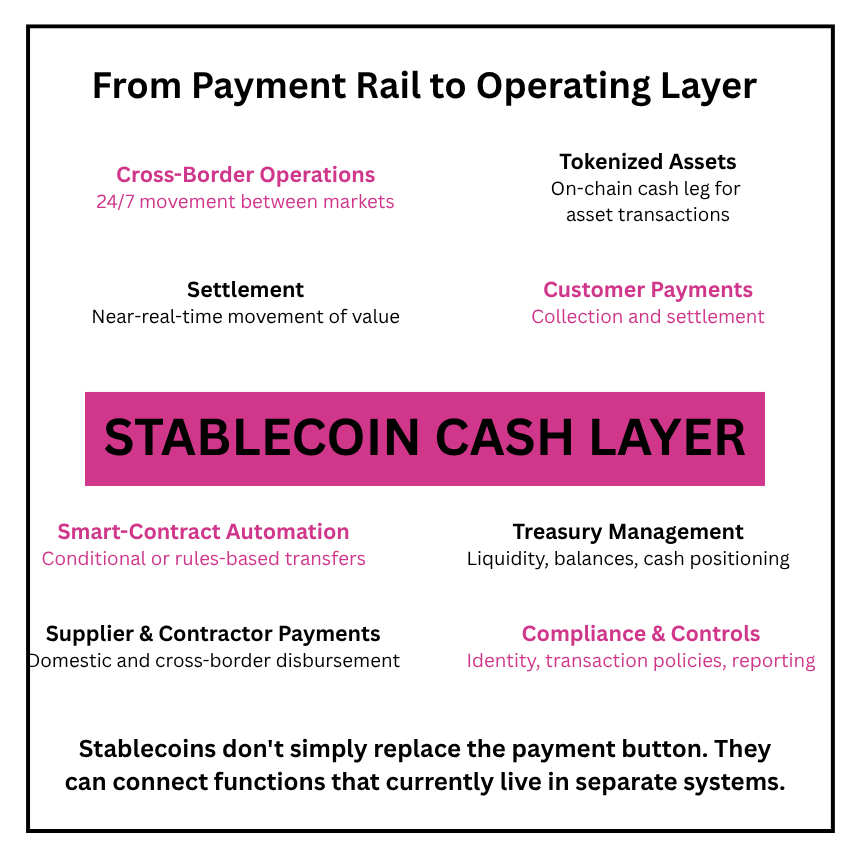
From Payment Rail to Operating Layer
Stablecoins are easy to understand when they are presented as digital dollars that move quickly.
But speed is only one feature. The deeper possibility is that money becomes capable of operating within the same digital environment as the activities surrounding it.
- A customer transaction can connect more directly to settlement.
- Treasury can interact with continuously available digital cash.
- Business rules can interact with payments.
- Cross-border transfers can become part of a broader liquidity strategy.
- Tokenized assets can have a compatible cash leg.
- Financial activity that once moved through several disconnected systems can potentially begin to share common infrastructure.
Not every business needs that architecture. And not every financial process should move onto it. But that is the strategic question stablecoins now raise.
Not simply: Can we send money this way?
But: What could our business do differently if money itself became part of the software?