

Companies rarely enter Web3 through a single, company-wide transformation.
They enter through a use case.
A treasury team may experiment with programmable payments. A supply-chain team may test a shared record system. A customer-experience team may explore digital credentials, tokenized membership, or stablecoin payments. Each initiative may use similar underlying technologies, but they create value in very different parts of the business.
That leads to one of the first useful distinctions in enterprise Web3 strategy:
Is the proposed use case primarily internal or external?
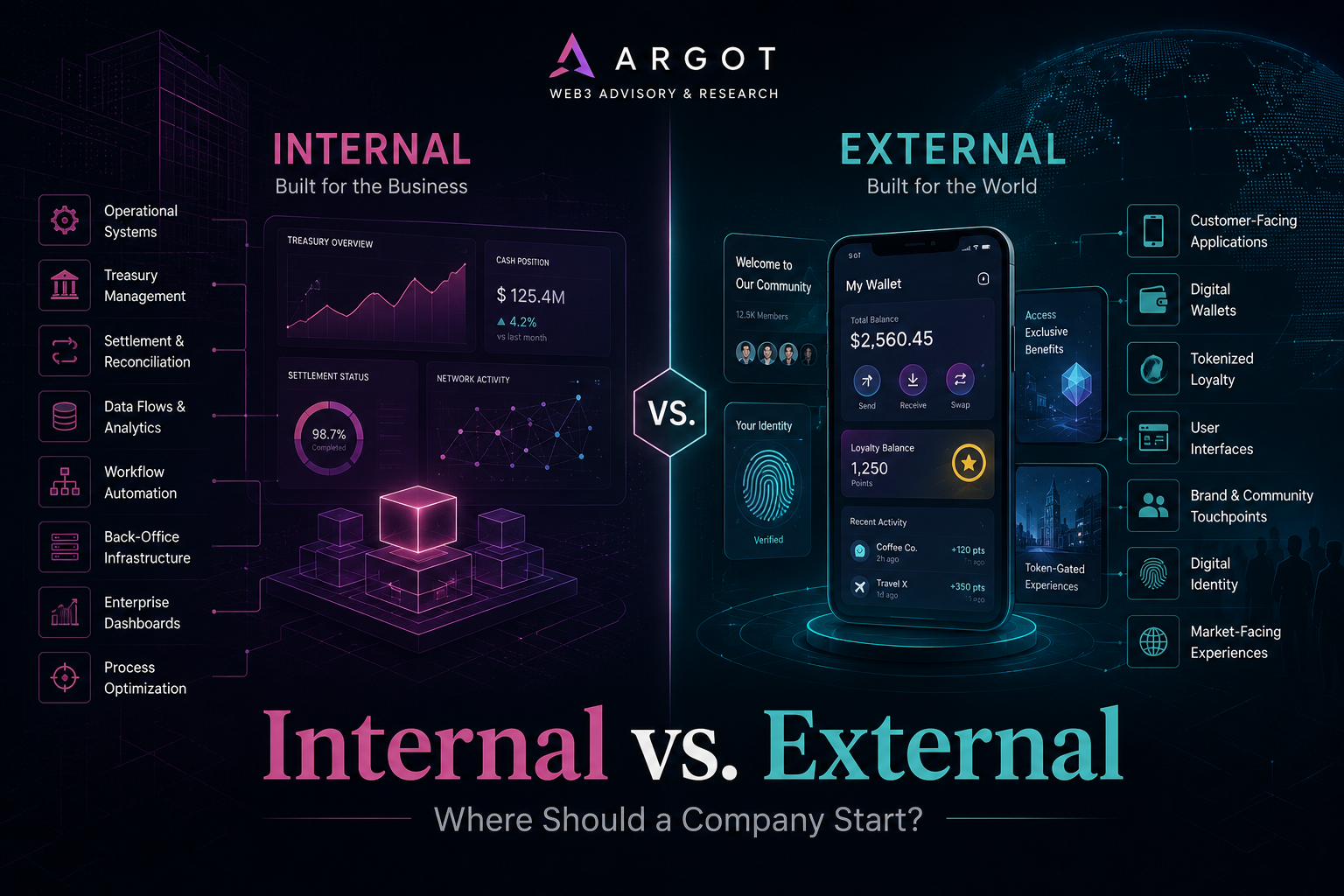
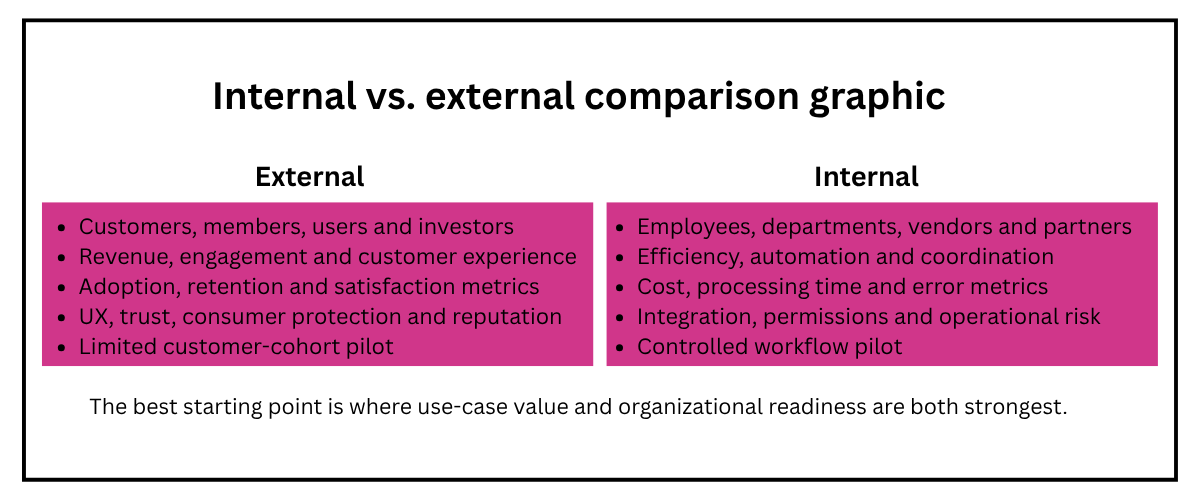
An internal use case improves how the organization operates. An external use case changes how the organization interacts with customers, users, members, suppliers, investors, or the broader market.
Neither path is automatically better. Neither is automatically safer. But they require different capabilities, expose the company to different risks, and should be measured in different ways.
Choosing between them can help a company move from broad interest in Web3 to a practical first initiative.
What is an internal Web3 use case?
An internal use case applies blockchain, smart contracts, tokenization, digital identity, or related infrastructure to an operational process.
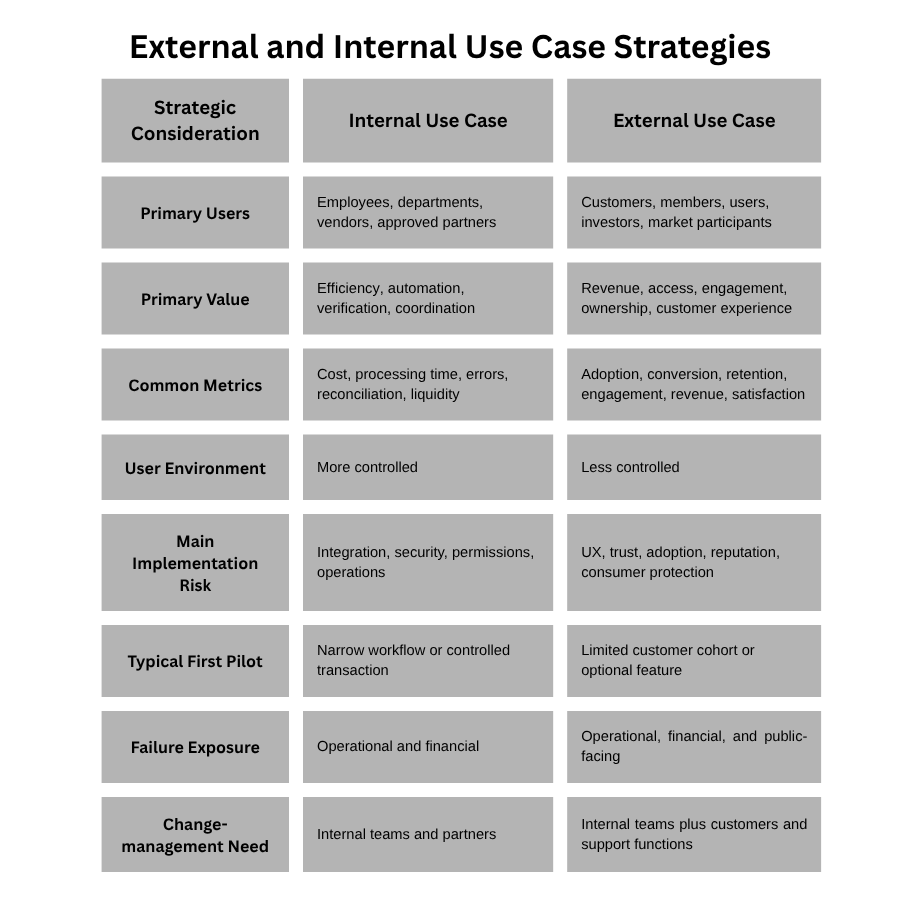
The immediate users are generally employees, business units, approved vendors, financial counterparties, or trusted partners. Customers may eventually benefit, but they do not necessarily interact with the technology directly.
Internal applications can include:
- Treasury management and intragroup payments
- Automated vendor or contractor payments
- Reconciliation between departments or counterparties
- Supply-chain tracking and provenance
- Document and credential verification
- Shared compliance or audit records
- Smart-contract-based workflow automation
- Tokenized collateral or asset management
- Data exchange between approved organizations
The value is usually operational. The company is trying to reduce delays, manual work, reconciliation costs, verification burdens, or coordination problems.
Financial infrastructure provides some of the clearest current examples. J.P. Morgan’s Kinexys platform supports blockchain-based payments, programmable transactions, asset tokenization, and near-real-time settlement for institutional clients. Siemens has used the platform for on-chain foreign-exchange payments, while Mitsubishi Corporation adopted it for intragroup cash management across several financial centers. These are not consumer crypto products. They are attempts to improve treasury and financial operations using blockchain-based infrastructure. See the Kinexys platform overview and Mitsubishi intragroup cash-management example. (JPMorgan Chase)
The technology matters, but it is not the starting point. The starting point is the operational friction:
- Funds cannot move when the business needs them.
- Several parties maintain inconsistent records.
- Transactions require repeated manual approval.
- Data must be reconciled across separate systems.
- Documents are difficult to authenticate.
- Contract conditions are monitored and enforced manually.
An internal Web3 initiative is useful only when the new infrastructure addresses one of those problems more effectively than an existing database, payment network, API, workflow tool, or enterprise-software solution.
Why companies often begin internally
For many organizations, an internal initiative can provide a more controlled environment for learning.
The company can limit participation to a known group. It can establish permissions before launch. It can test the system alongside an existing process. It can observe how the infrastructure performs without requiring customers to understand wallets, tokens, blockchains, or new forms of digital ownership.
Internal pilots may also produce relatively clear measurements.
A treasury pilot can measure settlement time, liquidity availability, transaction costs, failed payments, or manual interventions. A verification project can measure processing time, fraud rates, document errors, or administrative expense. A shared-ledger pilot can measure reconciliation effort and dispute frequency.
This makes internal adoption particularly useful for capability-building. The organization learns how to evaluate vendors, govern wallets and permissions, review smart contracts, handle digital assets, integrate data, and coordinate legal, compliance, technical, and operational teams.
However, internal does not mean risk-free.
An internal system may still handle money, sensitive information, contractual rights, regulated assets, or critical business processes. It may introduce cybersecurity exposure, vendor dependency, custody questions, data-governance problems, or integration failures.
The advantage is not that internal use cases eliminate risk. It is that the organization may be able to contain the number of users, systems, and relationships exposed during the first experiment.
What is an external Web3 use case?
An external use case directly changes the experience offered to customers, users, members, creators, investors, suppliers, or other market participants.
These applications may include:
- Stablecoin payments or payouts
- Wallet-based login and verification
- Digital credentials
- Tokenized loyalty and rewards
- Membership and access passes
- Customer ownership or participation models
- Tokenized products or financial assets
- Digital tickets and transferable rights
- Community governance or participation systems
- Blockchain-based marketplaces
Here, the value proposition is usually connected to growth, customer experience, access, trust, engagement, or the creation of a new product.
An external payment system might give customers another way to pay or receive funds. A digital credential could allow users to prove an attribute without repeatedly submitting the underlying personal information. A tokenized membership could make access, benefits, or status portable across experiences. A digital asset could represent a claim, entitlement, ticket, membership, or financial interest.
Mastercard’s stablecoin initiatives illustrate this customer- and merchant-facing direction. The company has developed systems intended to let consumers spend stablecoins, merchants receive payments, and exchange users send digital assets through simplified aliases rather than complex wallet addresses. Its Crypto Credential service also verifies certain information about participating users and wallets before a transfer is completed. Read Mastercard’s stablecoin payments announcement and Crypto Credential overview.
Digital identity provides another important model. The European Union’s Digital Identity Wallet is not simply a corporate Web3 product, but it demonstrates the broader movement toward portable, user-controlled digital credentials. The wallet is designed to let individuals store and selectively share identity information and documents when accessing public or private services. EU member states are required to make wallets available by the end of 2026. See the European Commission’s digital identity overview.
For businesses, this creates a strategic question that extends beyond any one platform:
What changes when customers can carry verified identity, credentials, assets, access rights, and payment capabilities with them rather than recreating those relationships inside every company’s closed system?
That is where external Web3 adoption can become more than a technical upgrade. It can change the structure of the customer relationship.
External use cases create a larger exposure surface
External projects can produce greater market visibility, but they also introduce a wider range of failure points.
A customer-facing initiative must work for people who are not interested in the underlying technology. The experience must be intuitive. Recovery procedures must be clear. Customer support must understand the product. Legal rights must be defined. Marketing claims must match what the system actually delivers.
A technically successful product can still fail because:
- Customers do not understand why they should use it.
- Wallet setup creates unnecessary friction.
- Users fear losing access or sending assets incorrectly.
- The token or credential provides no meaningful benefit.
- Customer-service teams cannot resolve problems.
- The system creates privacy concerns.
- The legal meaning of the asset or right is unclear.
- The initiative is presented as a speculative crypto product rather than a useful service.
This is why the Web3 layer should often become nearly invisible.
A customer should not need to understand consensus mechanisms to receive a faster payment. A loyalty-program member should not need to study token standards to access a benefit. A user should not need to manage a complicated wallet merely to verify age, membership, or eligibility.
The customer should experience the value, not the infrastructure diagram.
The categories can overlap.
A stablecoin settlement system might be internal for a financial institution but external for a customer receiving a stablecoin payout. A digital identity system may begin as an internal employee credential and later become a customer verification service. A tokenized asset may improve internal recordkeeping while also creating an external investment product.
The important question is not how the company labels the technology. It is where the behavior changes, who assumes the risk, and who receives the value.
When an internal use case should come first
An internal initiative may be the stronger starting point when:
- The most measurable problem is operational.
- The company needs to build technical and governance capability.
- Customer demand has not yet been demonstrated.
- The organization wants to test infrastructure before attaching it to a public product.
- The proposed system can run alongside an existing process.
- The pilot can be limited to known users and counterparties.
- Success can be measured through cost, time, error, or risk reduction.
This path allows the company to learn before asking customers to change their behavior.
It is particularly useful when the organization is still deciding how wallets, custody, smart contracts, permissions, data, vendors, and compliance responsibilities should be managed.
When an external use case should come first
An external initiative may be justified when:
- A specific customer problem is already clear.
- The Web3 component creates a benefit users cannot receive through the current model.
- Customers do not need to understand the technology to use the product.
- The company has the support, legal, compliance, and security capabilities to operate it.
- A limited cohort can test the experience before a broader launch.
- The organization can define what the customer owns, controls, or is entitled to.
- The product has a credible path beyond a promotional campaign.
A digital-native business may be able to begin externally because its users already use wallets or digital assets. A financial institution may launch an external tokenized product because it already possesses the necessary compliance, custody, and operational infrastructure.
The decision depends on readiness, not novelty.
The right answer may be a hybrid model
Many enterprise Web3 systems are neither purely internal nor purely external.
They combine an external experience with internal infrastructure and controls.
A customer might receive a tokenized credential, while the company maintains identity verification, customer support, consent records, and compliance processes off-chain. A user may make a stablecoin payment, while the merchant receives traditional currency through a payment provider. A token may represent an ownership interest, while legal enforceability continues to depend on contracts, custodians, administrators, and courts.
Enterprise Web3 generally operates as part of a larger business system—not as an isolated blockchain application.
The strategic work is therefore not simply deciding what goes on-chain. It is defining the complete operating model:
- What does the blockchain record?
- What remains in existing systems?
- Who can access or modify information?
- Who controls keys and permissions?
- What legal right does a token or credential represent?
- Who resolves mistakes and disputes?
- How does the system interact with customers?
- What happens if a vendor, wallet, or smart contract fails?
These questions determine whether the initiative can operate in the real world.
A framework for choosing the first use case
Before choosing between an internal and external initiative, leadership should answer six questions.
1. Where is the actual business friction?
Begin with the process, relationship, or customer experience that is currently expensive, slow, fragmented, difficult to verify, or unnecessarily dependent on intermediaries.
2. Who must change their behavior?
An internal pilot involving twenty trained employees is different from a product requiring thousands of customers to adopt a new wallet or payment method.
3. What does Web3 improve?
The use case should benefit from at least one distinctive capability: shared verification, programmable value, portable identity, digital ownership, transparent provenance, or settlement across organizational boundaries.
4. How will success be measured?
The pilot should have a small set of decision-grade metrics. “We launched it” is not a success measure.
5. What happens if the experiment fails?
Leadership should understand the potential operational, financial, legal, customer, and reputational consequences before choosing the pilot scope.
6. What is the smallest experiment that can produce useful evidence?
The first initiative should be large enough to test a real assumption but contained enough to stop, redesign, or reverse.
This creates a simple decision principle:
Start where the use-case fit is strongest, the evidence can be measured, and the organization is ready to manage the consequences.
The objective is not to choose a side
Internal and external Web3 use cases are not competing philosophies.
They are two entry paths into the same larger transition: the use of digital infrastructure to represent and coordinate money, identity, rights, assets, access, and trust.
An internal project can build the capabilities required for a later customer-facing product. An external experiment can reveal operational requirements that the company must solve internally. A successful adoption strategy may move back and forth between the two.
The wrong first initiative is usually one chosen because it looks innovative.
The right first initiative is one that teaches the company something important:
- Whether the technology solves the intended problem
- Whether the organization can govern it
- Whether users will accept it
- Whether the economics justify it
- Whether the company should stop, refine, expand, or scale
That is how Web3 adoption becomes a disciplined business process rather than an open-ended technology experiment.
Where should your organization begin?
Argot’s 2026 Web3 Adoption Report provides a practical framework for identifying viable use cases, assessing readiness, designing controlled pilots, and deciding when an initiative is ready to move toward integration and scale.
[Internal link: Download the 2026 Web3 Adoption Report]
Argot helps businesses determine where Web3 creates practical value—and where it adds unnecessary complexity. Explore Argot’s Web3 strategy and systems approach.