

Tokenization is often described as though putting an asset on a blockchain fundamentally transforms the asset itself. Sometimes it does change important things. But not everything.
A tokenized Treasury bond is still a Treasury bond.
A tokenized real estate interest is still ultimately a claim on real estate.
A tokenized fund still depends on the assets, manager, legal structure, and investment strategy behind the fund.
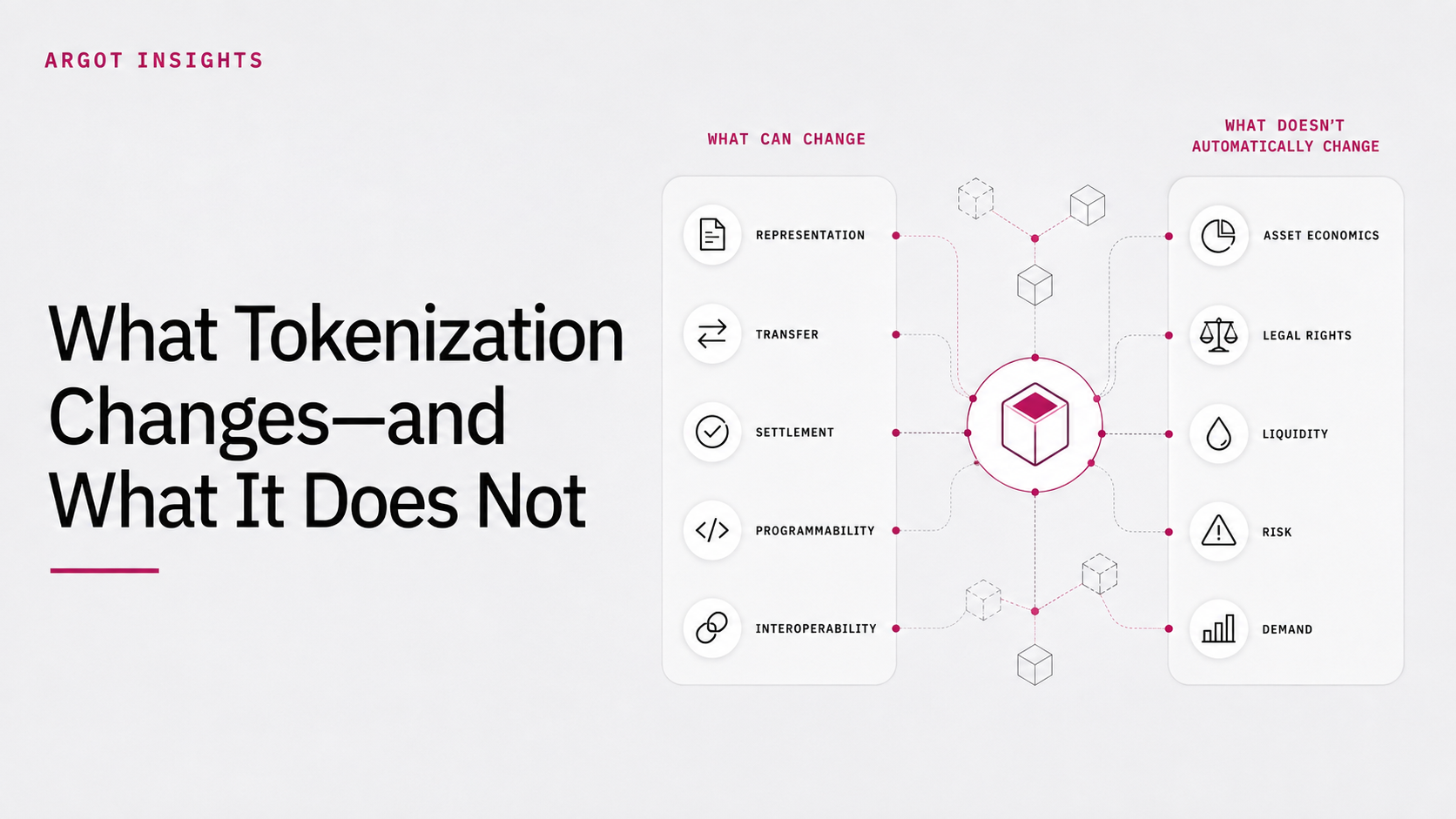
Moving an asset onto blockchain infrastructure can change how ownership is recorded, how transactions settle, how the asset interacts with other systems, and how certain processes are automated.
It does not automatically improve the economics of the underlying asset. That distinction is essential for businesses evaluating tokenization.
The right question is not: What happens if we turn this asset into a token?
It is: Which parts of the asset's lifecycle become meaningfully better if ownership and transactions move onto programmable digital infrastructure?
That is where the real value of tokenization begins.
Tokenization Changes Representation
At its simplest, tokenization changes how an asset or claim is represented.
Traditional financial and commercial assets are already digital in many respects.
Ownership records live in databases. Securities are held electronically. Bank balances are database entries. Contracts are stored digitally.
Tokenization therefore does not mean taking something that was previously physical and suddenly making it digital.
The more important change is that the representation of ownership can exist on a shared blockchain-based ledger. A token might represent a security, a fund interest, a claim on real property, a commodity, a payment entitlement, or another type of right.
That creates the possibility that the ownership record itself can interact with the infrastructure used to transfer, settle, and program transactions. This is the foundation for most of the other potential benefits.
Tokenization Changes Transfer
Traditional assets usually move through systems built around specific institutions and intermediaries.
A securities transaction may involve a broker, exchange, custodian, clearing organization, settlement system, and banking network.
Different organizations maintain different records throughout the process. Tokenization can allow ownership to move through shared digital infrastructure. That can reduce some of the coordination required between separate systems. It can also change when assets are transferable.
Traditional financial markets operate within established trading and settlement windows. Blockchain networks can operate continuously. That does not mean every tokenized asset should trade twenty-four hours a day.
Market makers, custodians, compliance systems, issuers, and investors all need to support that environment. But technically, the asset is no longer constrained by the same infrastructure that historically determined when ownership records could be updated.
That creates new possibilities for how markets operate.
Tokenization Can Change Settlement
One of the most important potential benefits of tokenization is the relationship between execution and settlement.
In traditional markets, a trade and its final settlement are often separate events. The parties agree to a transaction. Then securities and cash move through different pieces of infrastructure until ownership and payment are finally exchanged.
That delay exists for good reasons, including operational controls and risk management. But it also creates counterparty exposure, collateral requirements, reconciliation work, and operational complexity.
Tokenized assets create the possibility of bringing execution and settlement closer together.
If both the asset and the means of payment exist on compatible digital infrastructure, the two sides of the transaction can potentially move together. The asset changes hands. The payment changes hands. Settlement becomes part of the transaction itself rather than a later administrative process.
That does not eliminate every settlement risk. It does, however, change the architecture through which those risks are managed.
Tokenization Changes What Can Be Programmed
Traditional financial assets come with rules.
- Who is permitted to own them?
- When can they be transferred?
- What happens when interest is paid?
- How are distributions calculated?
- What restrictions apply to particular investors?
Much of this is currently managed through contracts, institutional processes, databases, compliance systems, and intermediaries.
Tokenized infrastructure makes it possible for some of those rules to become part of the asset's digital environment.
- A transaction might be permitted only between approved counterparties.
- A distribution might occur according to predefined conditions.
- Transfer restrictions might be enforced automatically.
- An asset could potentially interact with collateral, lending, settlement, or treasury systems through software.
This is where tokenization becomes more than simply recording ownership differently. The asset becomes capable of participating in programmable workflows. But there is an important limitation.
Encoding a rule into software does not make the underlying legal or business rule disappear. Someone still has to determine what the rule should be. Someone still has to decide how exceptions are handled. And the software still has to correspond with enforceable legal rights.
Programmability changes execution. It does not eliminate governance.
Tokenization Can Improve Interoperability
One of the less obvious advantages of tokenized assets is their potential ability to interact with other assets and applications using common technical infrastructure.
In traditional finance, interoperability is often built through integrations between individual institutions.
One system connects to another. APIs are developed. Data formats are translated.
Relationships must be established between each participant.
Blockchain infrastructure can create a different environment.
If multiple assets operate according to compatible standards on shared networks, applications can potentially interact with them more easily.
A tokenized asset could move into a custody platform.
- It could potentially be pledged as collateral.
- It could be exchanged against a stablecoin.
- It could interact with an automated settlement mechanism.
- It might be incorporated into other financial products.
This composability is one reason tokenization may ultimately matter beyond simply making individual assets easier to transfer. The greater opportunity may come from connecting previously fragmented pieces of financial infrastructure.
Tokenization Can Change Access
Tokenization is also frequently associated with broader access to assets. That is partly justified.
Digital distribution can make it easier to reach investors across different platforms or geographic markets. Assets can potentially be divided into smaller units.
Onboarding and administration may become more automated.
New distribution channels can emerge.
But this is also where claims about tokenization frequently become exaggerated. Technical accessibility is not the same thing as legal accessibility.
A security does not stop being regulated because it is represented by a token. Investor eligibility requirements do not necessarily disappear.
Jurisdictional restrictions remain. Disclosure obligations remain. Custody requirements may remain.
Tokenization can change the mechanism through which investors interact with an asset. It does not automatically change who is legally permitted to own it.
Tokenization Does Not Create Value
This may be the most important limitation. Tokenization does not make a bad asset good.
If an investment has weak cash flows before tokenization, those cash flows remain weak afterward.
If a company has poor credit quality, representing its debt on a blockchain does not improve its creditworthiness.
If a real estate project is overpriced, fractionalizing it into tokens does not make the underlying property more valuable.
If an asset produces no economic return, putting it on-chain does not suddenly create one.
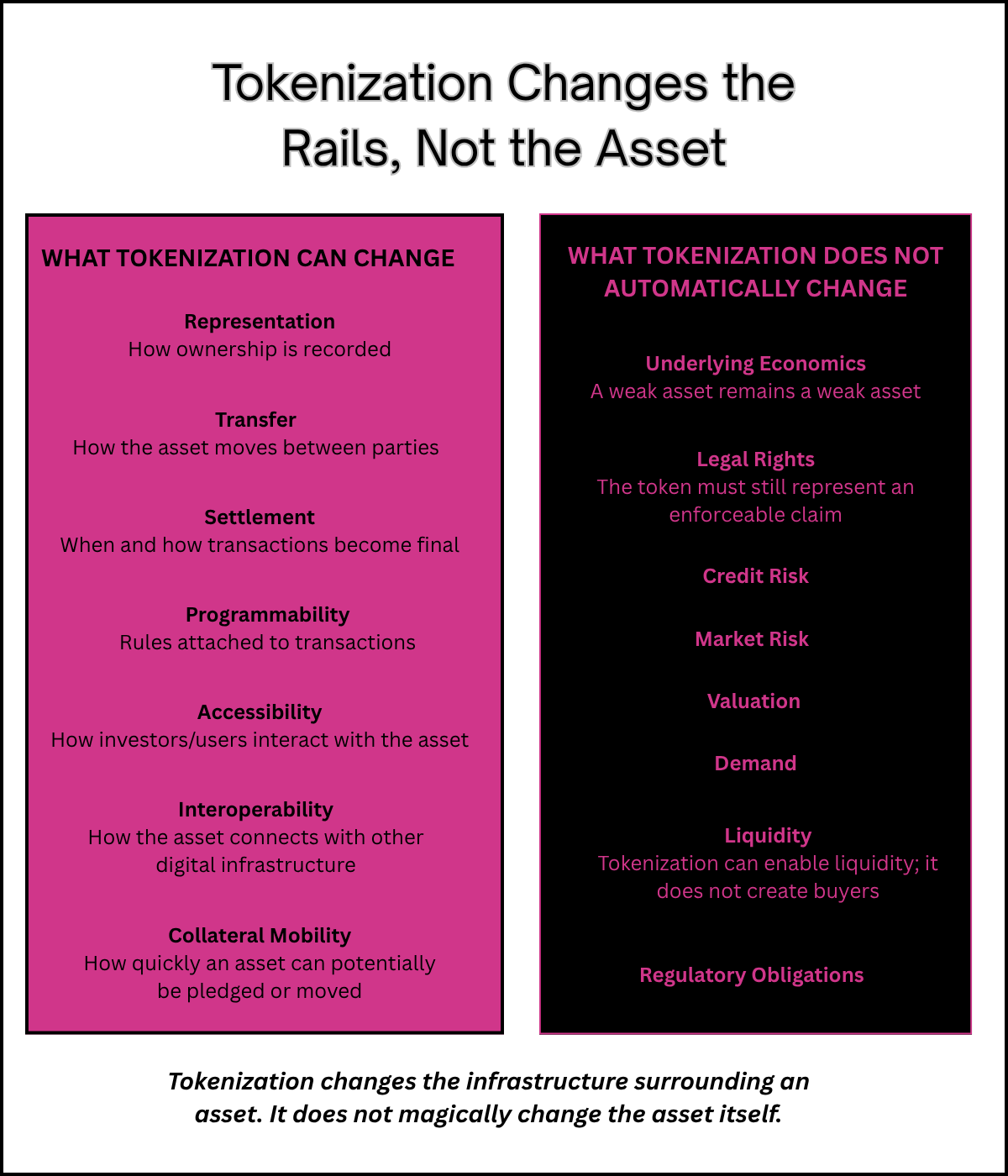
The value of an asset still comes from the underlying economics. Tokenization changes the infrastructure surrounding the asset. It does not replace fundamental analysis.
For businesses exploring tokenization, this distinction can prevent a great deal of wasted effort.
The question is not whether tokenization makes an asset more exciting.
The question is whether changing the infrastructure makes the asset easier, cheaper, safer, or more useful to own and transact.
Tokenization Does Not Automatically Create Liquidity
Liquidity is one of the most common promises associated with tokenization.
The argument appears straightforward. Turn an illiquid asset into divisible digital tokens. Allow those tokens to trade more easily. Liquidity improves.
But liquidity is not primarily a technology problem. Liquidity requires buyers and sellers.
It requires market depth. It requires pricing information. It often requires market makers, distribution, investor demand, and confidence in the underlying asset.
A token can make an asset more transferable without making it more liquid. That distinction matters.
Consider a privately held real estate investment. Tokenization might make it technically possible to transfer a $1,000 interest instead of requiring someone to purchase a much larger stake.
That could expand the potential market. But if few people want to buy the asset, the token may still trade infrequently. Tokenization can remove barriers to liquidity. It cannot manufacture demand.
Tokenization Does Not Automatically Change Legal Ownership
Another common misconception is that possession of a token necessarily means ownership of the underlying asset. That depends entirely on the legal structure.
A token might represent direct ownership.
- It might represent a contractual claim.
- It might represent an interest in an entity that owns the asset.
- It might provide economic exposure without conveying legal title.
- It could even represent little more than a record maintained by an issuer.
The blockchain can establish who controls a token. It cannot, by itself, determine what that token legally represents.
That relationship must be established through contracts, securities law, property law, corporate structures, regulatory frameworks, and other legal mechanisms.
For tokenization projects, the legal architecture is therefore just as important as the technical architecture. If the relationship between the token and the underlying right is unclear, the technology has not solved the ownership problem. It has simply created a digital representation of an unresolved one.
Tokenization Does Not Eliminate Risk
Every underlying asset carries risks.
- Credit risk.
- Market risk.
- Operational risk.
- Counterparty risk.
- Liquidity risk.
- Legal risk.
- Regulatory risk.
Tokenization may reduce certain operational risks while introducing new ones.
- Smart contracts can contain vulnerabilities.
- Private keys can be compromised.
- Blockchain networks can experience technical problems.
- Custody models can fail.
- Bridges and integrations can introduce additional risk.
- Governance structures may be unclear.
The objective should not therefore be to describe tokenized assets as inherently safer.
The more useful question is: Which risks are reduced, which remain unchanged, and which new risks are introduced by the tokenized structure?
That is a much more realistic basis for evaluating a project.
Tokenization Does Not Remove Intermediaries
Blockchain is frequently associated with disintermediation.
In practice, tokenization is more likely to change the role of intermediaries than eliminate them.
Issuers will still exist. Custodians may still exist. Broker-dealers, transfer agents, exchanges, administrators, banks, compliance providers, and market makers may continue to play important roles. But their functions may change.
Some activities that currently require manual verification or reconciliation may become automated. Some intermediaries may operate directly on shared infrastructure. New service providers may emerge around custody, identity, compliance, token administration, and interoperability.
The result is not necessarily a world without intermediaries. It may instead be a world with a different institutional architecture.
The Real Test: Does Tokenization Improve the Asset Lifecycle?
The best way to evaluate tokenization is to examine the full lifecycle of the asset.
Issuance
Can the asset be created or distributed more efficiently?
Ownership
Does tokenization provide a clearer or more interoperable ownership record?
Transfer
Can the asset move more efficiently between eligible participants?
Settlement
Can ownership and payment be exchanged with less delay or reconciliation?
Servicing
Can distributions, reporting, or other obligations be automated?
Collateral and Financing
Can the asset move more easily into lending or collateral arrangements?
Secondary Markets
Does the structure reduce barriers preventing buyers and sellers from interacting?
Compliance
Can regulatory and contractual requirements be incorporated more effectively into the transaction process?
If tokenization meaningfully improves several of these functions, the business case may be compelling.
If it changes little beyond the format of the ownership record, the benefit may be much smaller.
Tokenization Changes the Rails
The easiest way to think about tokenization is to separate the asset from the infrastructure surrounding the asset.
The underlying asset determines economic value. The infrastructure determines how that value is recorded, transferred, settled, administered, and connected to other systems.
Tokenization primarily changes the second category.
- It can change representation.
- It can change transfer.
- It can change settlement.
- It can introduce programmability.
- It can improve interoperability.
- It can reduce some administrative friction.
- And it can create new ways for assets and money to interact within digital financial infrastructure.
What it cannot do is override the fundamentals.
- It cannot create demand where none exists.
- It cannot turn poor credit into good credit.
- It cannot make legal ambiguity disappear.
- It cannot eliminate regulation.
- It cannot guarantee liquidity.
- And it cannot make an unattractive asset valuable simply because ownership is represented by a token.
That distinction is what businesses should keep in mind as tokenization moves from experimentation toward practical implementation.
The opportunity is real. But it is not magic. Tokenization matters when it improves the infrastructure through which an asset operates. The asset itself still has to be worth owning.