


The Problem Isn’t the Technology
Over the past few years, many companies have experimented with Web3.
They’ve launched NFT campaigns.
Tested token-based loyalty programs.
Explored blockchain integrations.
Some saw early engagement. Most did not.
And a significant number quietly abandoned their pilots altogether.
The common explanation is that Web3 is still “too early.”
That explanation is convenient—but incomplete.
The real issue is not that Web3 pilots fail because of the technology.
They fail because of how they are designed.
Most Web3 Pilots Start with the Wrong Question
Many organizations begin with: “How do we use Web3?”
Instead of: “What problem are we trying to solve?”
This leads to solutions in search of a use case.
- launching NFTs without a clear purpose
- issuing tokens without meaningful utility
- experimenting without defined outcomes
The result is predictable:
- short-term curiosity
- limited engagement
- no sustained value
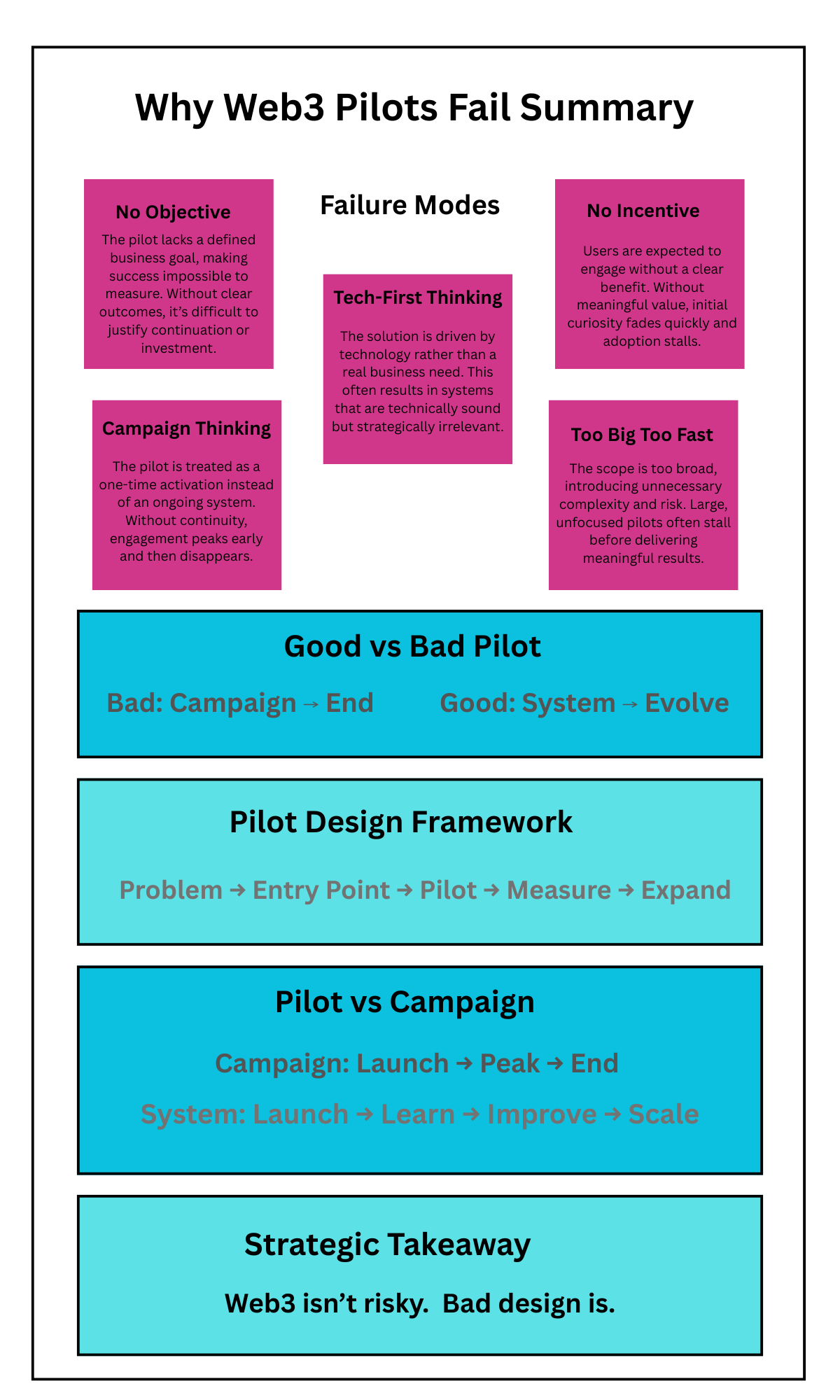
Failure Mode 1: No Clear Business Objective
The most common issue is also the simplest.
The pilot does not have a clearly defined goal.
Is the objective to:
- increase customer retention?
- reduce operational costs?
- test new revenue models?
Without a clear objective, it becomes impossible to measure success.
And without measurable success, pilots are difficult to justify—or scale.
Failure Mode 2: Over-Indexing on Technology
Web3 pilots often start with the technology itself:
- blockchain selection
- token mechanics
- technical architecture
But technology is not the constraint. The constraint is alignment between the system and the business.
When pilots are designed from the inside out, they often miss:
- user behavior
- customer experience
- real-world usability
Failure Mode 3: No User Incentive
Many Web3 pilots assume that novelty is enough.
It isn’t.
Users don’t engage because something is “on-chain.” They engage because it creates value for them.
Successful systems answer:
- Why should a user participate?
- What do they gain?
- Is the experience better than existing alternatives?
Without clear incentives, engagement quickly fades.
Failure Mode 4: Treating Pilots as Campaigns
This is especially common in marketing-driven initiatives.
Web3 is treated like a campaign:
- launch
- promote
- measure
- end
But Web3 systems are not campaigns.
They are ongoing systems of interaction and value exchange.
When pilots are treated as one-off activations, they fail to create lasting impact.
Failure Mode 5: Starting Too Big
Some organizations approach Web3 as a large-scale transformation.
They attempt to:
- redesign entire systems
- integrate across multiple functions
- deploy complex infrastructure
This introduces:
- long timelines
- high costs
- internal resistance
And often leads to stalled execution.
What Successful Web3 Pilots Do Differently
The companies seeing traction follow a different approach.
They don’t try to “adopt Web3.”
They design focused, intentional experiments.
1. They Start with a Specific Problem
Instead of starting with technology, they start with friction:
- customer drop-off
- inefficient processes
- limited engagement
Then ask: Can Web3 meaningfully improve this?
2. They Choose the Right Entry Point
They map the problem to a clear starting point:
- Entry → identity and access
- Loyalty → engagement and incentives
- Infrastructure → operations and automation
This keeps pilots focused and manageable.
3. They Design for Users, Not Systems
Successful pilots prioritize:
- simplicity
- usability
- clear value
They remove complexity wherever possible.
Users don’t need to understand Web3—they need to benefit from it.
4. They Measure the Right Things
Instead of vanity metrics, they track:
- retention
- repeat engagement
- cost efficiency
- behavioral change
This creates a clear path to scaling.
5. They Treat Pilots as Systems, Not Experiments
The most important difference:
Successful pilots are designed with continuity in mind.
They are not built to end—they are built to evolve.
A Better Way to Think About Web3 Pilots
A Web3 pilot should not be viewed as:
- a campaign
- a marketing experiment
- a technology test
It should be viewed as: A controlled implementation of a new system design
This mindset shift changes how pilots are:
- scoped
- executed
- evaluated
The Strategic Takeaway
Most Web3 pilots fail for predictable reasons:
- no clear objective
- no user incentive
- too much focus on technology
- treating systems like campaigns
The companies that succeed take a different path.
They start small.
They focus on real problems.
They design for users.
They build for continuity.
Web3 is not inherently risky. Poorly designed pilots are.
Building Smarter Pilots
At Argot, we help organizations design Web3 pilots that are aligned with business objectives and structured for long-term value.
Because the goal is not experimentation for its own sake.
It is learning that leads to advantage.
→ Learn more at argotagency.io