


For many business leaders, Web3 still feels like a high-risk arena.
The language is unfamiliar. The regulatory environment is uneven. The technology can feel abstract. And the public conversation around crypto, tokens, NFTs, and decentralized finance has often been loud enough to obscure the practical business questions underneath.
That creates a strategic problem.
If a company ignores Web3 entirely, it may miss early signals of a major shift in how value, identity, data, ownership, and trust move across digital networks. But if it rushes in without a clear business reason, it risks spending money on a technology project that produces confusion instead of insight.
The right starting point is neither avoidance nor overcommitment.
It is a low-risk experiment.
A low-risk Web3 experiment is not a press release. It is not a token launch. It is not an abstract “innovation initiative.” It is a contained business test designed to answer one practical question:
Can a Web3-based tool improve a real workflow, reduce friction, create trust, unlock a new customer behavior, or reveal a new business model?
That distinction matters. Deloitte describes enterprise blockchain and digital asset work in terms of helping organizations “analyze, prioritize, and pilot innovative financial products and services.” That is the right mindset. The first goal is not transformation. The first goal is disciplined learning.
Start with the business problem, not the technology
The easiest way to make a Web3 initiative risky is to begin with the wrong question.
The wrong question is: “How can we use blockchain?”
The better question is: “Where does our business rely on trust, verification, coordination, ownership, or settlement — and where is that process slower, more expensive, or less transparent than it should be?”
That is where Web3 becomes interesting.
At its most basic level, blockchain technology creates a shared digital record that is difficult to alter after the fact. NIST describes blockchains as “tamper evident and tamper resistant digital ledgers” that allow a community of users to record transactions in a shared ledger. That does not mean every business process needs a blockchain. Most do not.
But it does point toward the kinds of problems where experimentation may be useful.
A good Web3 experiment usually begins in one of several areas:
- A verification problem
- A recordkeeping problem
- A coordination problem across multiple parties
- A digital ownership or rights-management problem
- A payments or settlement problem
- A customer engagement or loyalty problem
- A provenance or traceability problem
The experiment should not begin with a token. It should begin with a workflow.
What makes an experiment low-risk?
A low-risk Web3 experiment has boundaries.
It does not require the company to rebuild its technology stack. It does not expose the business to unnecessary regulatory risk. It does not put sensitive customer data on a public blockchain. It does not require a major public launch. It does not depend on speculative token economics. And it does not assume that decentralization is automatically better than an existing system.
Instead, a low-risk experiment is narrow, measurable, reversible, and tied to a clear business decision.
A good experiment should answer questions like these:
- Can this reduce manual reconciliation?
- Can this improve trust between parties that do not share the same internal system?
- Can this make a credential, certificate, or record easier to verify?
- Can this reduce fraud, duplication, or disputes?
- Can this create a better customer experience?
- Can this reveal whether customers, partners, or employees are ready for a new type of digital interaction?
That last point is important. The purpose of an experiment is not merely to test technology. It is to test behavior.
Will customers use it? Will partners trust it? Will employees understand it? Will legal, compliance, finance, and operations teams be able to support it? Will the business benefit justify the complexity?
A low-risk Web3 experiment helps answer those questions before the company makes a larger commitment.
Example 1: A credential verification pilot
One of the strongest low-risk Web3 use cases is credential verification.
Many organizations depend on credentials: professional certifications, training records, licenses, memberships, warranties, academic achievements, safety approvals, vendor qualifications, or compliance attestations.
Today, those records are often fragmented across PDFs, databases, emails, portals, and manual review processes. That creates friction. It can also create fraud risk, administrative burden, and poor customer or employee experiences.
A low-risk Web3 experiment could test whether one specific credential can be issued, held, and verified more efficiently using a standards-based approach. The W3C Verifiable Credentials Data Model provides a useful framework here. It defines a model for credentials involving issuers, holders, and verifiers, while also addressing security and privacy considerations.
This kind of pilot does not need to put private information on-chain. In fact, it should not. A responsible experiment can test whether cryptographic verification improves trust while keeping sensitive data off public infrastructure.
A company might start with one narrow credential: a training certificate for employees, a vendor compliance record, or a customer eligibility credential.
The success metrics could include:
- Time required to verify the credential
- Number of manual review steps eliminated
- Reduction in duplicate records
- User satisfaction
- Partner willingness to accept the credential
- Compliance comfort with the process
That is a real experiment. It tests whether Web3 improves a business process, not whether the company can produce a blockchain demo.
Example 2: A supply chain traceability test
Another low-risk Web3 experiment is a traceability pilot.
Supply chains often involve multiple companies, systems, jurisdictions, and recordkeeping standards. When something goes wrong — a defective component, a questionable supplier, a recall, a sustainability claim, or a compliance issue — companies need reliable records.
Blockchain is not a magic solution to supply chain problems. Bad data entered into a blockchain is still bad data. But blockchain-based systems can be useful when multiple parties need access to a shared, tamper-resistant record of events.
Deloitte has written about blockchain’s potential role in “supply chain transparency and traceability,” and this is a useful area for controlled experimentation.
A low-risk pilot might focus on one product line, one supplier relationship, one certification process, or one handoff between parties. The business question could be simple:
Can a shared record reduce disputes, improve auditability, or make provenance claims easier to verify?
Again, the pilot should be narrow. It should not attempt to “put the supply chain on-chain.” That is too broad. Instead, the company might test one high-friction workflow:
- Confirming receipt of goods
- Recording sustainability documentation
- Tracking chain-of-custody for a regulated product
- Verifying supplier certifications
- Creating an audit trail for a specific compliance requirement
The output should be evidence: fewer emails, faster audits, reduced disputes, better visibility, or clearer accountability.
Example 3: A loyalty or customer engagement experiment
Web3 also creates new possibilities around customer loyalty and engagement.
Many loyalty programs are closed systems. Points are issued by a company, redeemed inside that company’s ecosystem, and often forgotten by customers. Web3 introduces a different design space: portable digital assets, tokenized rewards, community access, digital collectibles, membership credentials, and interoperable benefits.
This does not mean every brand should launch an NFT project. In most cases, that is exactly the wrong starting point.
A low-risk customer experiment might test whether a small group of customers responds to a digital membership credential, an access pass, a collectible tied to a real-world benefit, or a tokenized reward that creates deeper engagement.
The question is not: “Can we create a digital asset?”
The question is: “Does this create a better customer relationship?”
A responsible pilot would avoid speculative language, avoid financial promises, and avoid creating confusion about whether the digital asset is an investment. It would focus on utility: access, recognition, participation, loyalty, or service improvement.
The company might test with a small customer segment, a limited campaign, or an internal community before expanding. The metrics could include activation rate, repeat engagement, redemption behavior, referral activity, or customer feedback.
If customers do not care, the company learns that quickly. If they do care, the company has evidence for a more thoughtful next step.
Example 4: A payments or settlement pilot
Payments are another area where Web3 experimentation may make sense, especially where settlement is slow, cross-border activity is expensive, or reconciliation creates administrative burden.
Stablecoins, tokenized deposits, and blockchain-based settlement systems are often discussed in this context. But for most companies, the first experiment should be very limited. It might involve a small internal treasury test, a controlled vendor payment flow, or a simulation with a trusted partner rather than a broad customer-facing rollout.
The key is to avoid turning a payments experiment into an uncontrolled compliance problem.
A low-risk payments pilot should involve legal, finance, tax, cybersecurity, and compliance teams from the beginning. It should define which assets are being used, which jurisdictions are involved, what reporting obligations exist, how custody is handled, and what happens if something goes wrong.
The goal is not to chase novelty. The goal is to understand whether a new payment rail can reduce friction in a specific context.
Keep the compliance perimeter tight
One of the most important features of a low-risk Web3 experiment is a clearly defined compliance perimeter.
That means the company should know:
- Who is participating
- What data is involved
- Whether any tokens or digital assets are being created
- Whether customers are involved
- Whether money, rewards, or financial claims are involved
- Which jurisdictions apply
- Which internal teams need approval
- How the experiment can be stopped
The OECD describes a regulatory sandbox as a “controlled environment” for understanding the opportunities and risks of specific innovations. That concept is useful even outside a formal government sandbox.
Businesses should think in the same way: controlled setting, defined participants, limited exposure, clear oversight, and a plan for what comes next.
A Web3 experiment becomes risky when it blurs boundaries. Is this a product or a test? Is the token a reward or a financial instrument? Is customer data being exposed? Who controls the wallet? Who is responsible for security? What happens if the vendor disappears? What happens if the technology fails?
These questions should be addressed before launch, not after.
Do not build everything yourself
A low-risk experiment should not require a company to become a blockchain infrastructure company.
In most cases, businesses should start by using existing tools, platforms, APIs, standards, or partners. The purpose of the experiment is to test business value, not to prove that the company can build every technical layer from scratch.
This is especially true for companies that are still learning. Web3 infrastructure involves wallets, custody, smart contracts, identity, security, compliance, analytics, user experience, and integration with existing systems. Building all of that internally is expensive and unnecessary for an initial pilot.
The better approach is to define the business question first, then choose the lightest technical setup that can answer it.
For some companies, that may mean a no-token prototype. For others, it may mean a permissioned blockchain environment. For others, it may mean working with an established vendor or using APIs that abstract away much of the underlying complexity.
Visa’s Tokenized Asset Platform reflects a broader trend toward making tokenized asset experimentation accessible through an API layer. Whether or not that specific platform fits a given company, the lesson is important: low-risk experimentation often depends on reducing technical complexity, not increasing it.
Measure learning, not hype
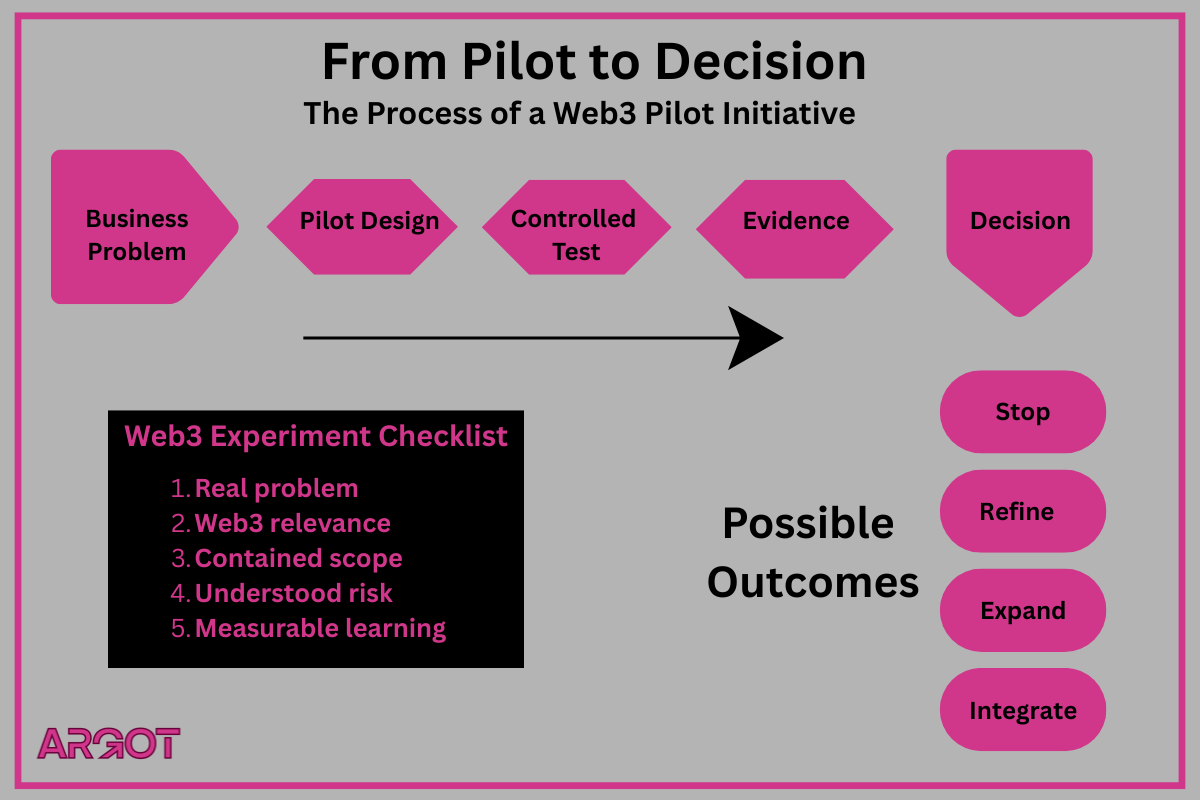
A Web3 experiment should end with a decision.
That decision might be:
- Stop
- Refine
- Run another pilot
- Expand to a larger group
- Integrate with an existing system
- Move toward production
- Revisit later when the market matures
Any of those outcomes can be valuable.
The only bad outcome is ambiguity: a pilot that produces excitement but no evidence, a demo but no decision, or a technical proof-of-concept that nobody in the business knows how to evaluate.
McKinsey has described tokenized financial assets as moving “from pilot to scale,” while also noting that adoption is not yet widespread. That is a useful reminder. The point of a pilot is not to pretend that everything is already mature. The point is to learn where maturity is emerging, where the company may have an advantage, and where further investment is justified.
Good Web3 experiments measure things like:
- Cost reduction
- Time savings
- Reduction in reconciliation
- Lower fraud or dispute risk
- Improved customer engagement
- Increased partner trust
- Better auditability
- Faster settlement
- Clearer data ownership
- Operational feasibility
- Regulatory comfort
The metrics should be chosen before the experiment begins.
What a good pilot brief should include
Before launching a Web3 experiment, a company should create a short pilot brief.
It does not need to be a fifty-page strategy document. In fact, it should be concise. But it should answer several basic questions.
- What business problem are we testing?
- Why might Web3 be relevant to this problem?
- What is the smallest version of the experiment that can produce useful evidence?
- Who needs to participate?
- What data, assets, or customer interactions are involved?
- What risks need to be controlled?
- What will we measure?
- What decision will we make at the end?
This structure keeps the experiment grounded. It prevents the company from drifting into technology theater. It also helps executives, legal teams, technical teams, and business units speak the same language.
The Argot low-risk experiment test
At Argot, we believe Web3 strategy should begin with business judgment, not technical enthusiasm.
Before a company launches a Web3 experiment, it should be able to answer five questions:
Is the problem real?
The experiment should address an existing business pain point, not a hypothetical future use case.
Is Web3 relevant?
The use case should involve trust, verification, ownership, coordination, settlement, provenance, or digital participation.
Is the scope contained?
The pilot should be limited by audience, workflow, data exposure, budget, duration, and operational impact.
Is the risk understood?
Legal, compliance, cybersecurity, finance, and data questions should be identified before the experiment begins.
Is the learning measurable?
The pilot should produce evidence that supports a decision: stop, refine, expand, or integrate.
If those five conditions are not met, the company is probably not ready to launch. It may need a readiness assessment, a better use-case filter, or a more disciplined pilot design.
The low-risk experiment is a strategy tool
The deeper value of a low-risk Web3 experiment is not just the immediate use case.
It is organizational learning.
A company that runs a disciplined Web3 experiment begins to understand the technology, the vendor landscape, the compliance questions, the customer experience challenges, and the business model implications. It learns what is real, what is premature, what is overhyped, and what may become strategically important.
That learning compounds.
The first experiment may be small. But it helps the company build judgment. And in a field as noisy as Web3, judgment is one of the most valuable assets a business can develop.
The goal is not to become a “Web3 company” overnight.
The goal is to become the kind of company that can recognize when Web3 matters, test it intelligently, and act before competitors who are still trapped between hype and hesitation.
That is what a low-risk Web3 experiment looks like.
It is narrow.
It is measurable.
It is controlled.
It is tied to a real business problem.
And most importantly, it gives the company a better basis for deciding what to do next.
Need help identifying the right Web3 experiment?
Argot helps companies assess where Web3 may create practical business value — and where it is likely to create unnecessary complexity.
Our Web3 Strategy & Readiness Diagnostic is designed to help leadership teams identify high-potential use cases, evaluate organizational readiness, and design low-risk experiments that produce evidence instead of hype.
If your company is exploring blockchain, digital assets, tokenization, decentralized identity, or Web3-enabled business models, the right first step is not a leap.
It is a disciplined test.